
Functional Medicine
What is Functional Medicine?
Functional medicine is a personalized, root-cause approach to healthcare that looks at how genetics, metabolism, hormones, inflammation, nutrition, gut health, stress, sleep, and environment influence long-term health. At Modern Brain-Body Health in Sonoma, CA, Dr. Elena Fowler, MD, uses functional and integrative medicine to help patients understand why symptoms are developing and create a plan to improve brain health, energy, hormones, metabolism, and healthy aging.
The foundation of functional medicine is built on a science-based approach that uses in-depth diagnostic testing and data collection to evaluate every system in the body to determine the underlying cause of a disease or disorder. Part of the data collection is an exhaustive medical review of a patient’s medical history, including examining a patient’s genetic, biochemical, lifestyle, and physiological factors.
At the core of this approach is the belief that every patient has unique biochemistry, genetics, lifestyle factors, environmental exposures, and stressors; that's why personalized testing and treatment plans are critical for patient success.
Ready to Take the Next Step?
If you are looking for a functional medicine doctor in Sonoma, CA who takes time to understand your symptoms, history, labs, and long-term goals, Modern Brain-Body Health can help you begin with a clear next step.
Schedule a Discovery Call
How is it Different from Conventional Medicine?
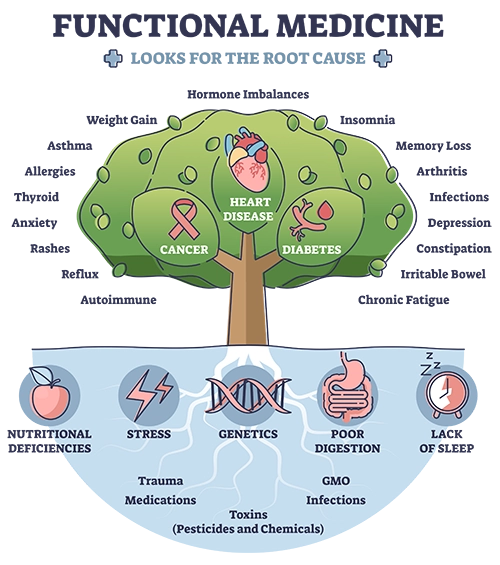
In conventional medicine, doctors treat the symptoms. This is like treating the diseased leaves on a tree. Relief may come with this approach, but the underlying root cause is not addressed. It leaves patients vulnerable to continued health decline.
In functional medicine, doctors see diseased leaves as a sign of disease or dysfunction within the tree or at its roots. Not only do the treatment plans from a functional medicine doctor provide relief from symptoms, but they also address the source of the disease, fortifying patients against continued health decline.
What Does a Functional Medicine Doctor Do?

A functional medicine doctor takes a holistic approach to healthcare by focusing on the underlying causes of a patient’s health issues.
They spend more time with patients to gather detailed information about their medical history, lifestyle habits, and environment to create a personalized treatment plan that may include lifestyle changes, nutritional supplements, and stress management techniques.
What Kind of Care Will I Receive?
By focusing on patterns and connections within the body, a systems biology-based approach allows for highly personalized treatment plans. Our treatment plans support not just symptom relief but also long-term wellness and disease prevention through a comprehensive understanding of the body’s interdependencies.
Our clinical team is always asking, “Why did this symptom start?” and “Why is it progressing?” We want to find the underlying cause of the disease. Searching for the person’s individual root cause and creating a holistic treatment plan makes the functional medicine approach highly effective for a variety of conditions.
Rather than just treating symptoms, the goal of a functional medicine doctor is to identify the root cause of a patient’s health issues and provide targeted treatment that promotes overall wellness.
This approach helps patients achieve better health outcomes and improve their quality of life.

Do You Take Insurance?
Our functional medicine clinic does not bill insurance. You may pay by check, credit card, or HSA debit card. Upon request, we can provide you with a copy of the superbill, which you can submit to your insurance company for possible reimbursement for out-of-network care. The superbill is a detailed medical receipt that contains procedure codes, diagnosis codes, and the fees charged for your office visit. We cannot guarantee what reimbursement, if any, you may receive. We do not submit claims or call insurance companies directly. This is the responsibility of the patient.
We do not participate with Medicare, nor do we bill Medicare for any services rendered. A patient can NOT submit superbills to Medicare for possible reimbursement.
Is lab work covered by insurance?
You have two common lab payment options, depending on whether you prefer cash-pay pricing or insurance reimbursement.
Option A: Cash-Pay
Option B: Insurance
Paying Cash
For patients who don’t have insurance that will cover their lab work, we’ve negotiated a cash price with LabCorp. Our entire initial panel can be between $150 and $300, depending on what the doctor needs to look into for your extensive foundational lab panel. Patients do need to understand that if you bill through insurance and they do not cover your lab work, it could cost you five to ten times as much, $2000 or more.
We leave it up to you to decide if you want to bill insurance or not. Most of our patients do the cash-priced lab work. It's also important to know that we do not mark up our lab work. When you pay cash for labs you get it at our discounted rate. It is very, very reasonable to get blood work done at cost.
When paying cash for labs, how does billing work?
You can think about it this way. It's an exchange in which the doctor's cash pricing is transferred directly to the patient. So it's just an exchange of funds. LabCorp bills the doctor, and then the practice bills the patient, and that's how it works.
As far as the advanced diagnostic testing, if there was a stool analysis or advanced hormone analysis, that all depends again on your insurance. We provide a super bill, which is a bill that you would provide to your insurance company. You would pay the lab directly, and then the lab would give you a super bill. Then you would submit it to your insurance, and you would get reimbursed based on your plan.
Insurance Reimbursement
During the Foundational Assessment, we do blood work, and it depends on the patient's insurance coverage and diagnostic codes whether insurance will cover the lab work. We do an extensive foundational lab panel that looks at sex hormones, thyroid, inflammatory markers, cancer risks, cardiovascular risks, and vitamins and minerals. For patients who have a lot of diagnoses and have good coverage, we run it through their insurance. If you tell the doctor you want it run through your insurance, you can attempt to get it covered that way.
Please feel free to call the office if you have any additional questions about billing.
Conditions We Treat
A Brain-Body, Systems-Based Approach
At Modern Brain-Body Health, we approach every condition with one central question:
Why did this symptom begin — and why is it progressing?
Rather than isolating organs or suppressing symptoms, Dr. Fowler practices through a brain-body systems model. The brain does not function in isolation. It is influenced by metabolism, hormones, inflammation, gut health, immune balance, sleep quality, stress physiology, and environmental exposures.
When one system destabilizes, others compensate — and eventually decline.

Our approach integrates advanced testing and clinical insight across:

- Metabolic health
- Hormone signaling
- Inflammation and oxidative stress
- Nutrient status
- Gut-brain interactions
- Immune function
- Environmental burden
- Genetic predispositions
We analyze patterns, not just diagnoses. Two patients may share the same condition, but the underlying drivers are often completely different. That is why treatment is never one-size-fits-all. Every plan is structured, personalized, and data-driven.
Our goal is not only symptom improvement — it is protecting cognitive function, strengthening resilience, and slowing long-term decline.
Brain & Cognitive Health
Cognitive changes rarely appear suddenly. Brain fog, reduced focus, slowed processing, and memory lapses often begin subtly — frequently tied to metabolic dysfunction, inflammation, hormone shifts, or chronic stress.
Dr. Fowler evaluates the full landscape influencing brain performance, including mitochondrial health, insulin resistance, nutrient sufficiency, sleep quality, and neuroinflammation.
Common Concerns We Address:
- Brain fog
- Memory concerns
- Reduced focus or executive function
- Cognitive decline prevention
- Fatigue related to cognitive overload
- Early cognitive changes
Endocrine & Hormonal Imbalances
Hormones are signaling messengers. When signaling becomes disrupted — through stress, inflammation, metabolic dysfunction, or aging — symptoms emerge.
The brain (hypothalamus and pituitary) directs the endocrine system. If upstream regulation falters, downstream hormones suffer. We evaluate the entire signaling cascade before considering replacement therapy.
Hormone therapy, when appropriate, is strategic — not automatic.
Concerns Addressed:
- Thyroid dysfunction (including Hashimoto’s)
- Adrenal dysregulation
- Female hormone imbalance (perimenopause, menopause)
- Low testosterone
- Insulin resistance
- Polycystic ovarian syndrome (PCOS)
- Metabolic & Cardiovascular Health
Metabolic Syndrome
Your brain is metabolically demanding. Insulin resistance, chronic inflammation, and dyslipidemia directly impact cognitive longevity.
We analyze advanced metabolic and cardiovascular biomarkers to assess both short-term risk and long-term trajectory.
Risk reduction focuses on lowering inflammation, improving insulin sensitivity, optimizing mitochondrial function, and stabilizing hormones.
We Commonly Address:
- Metabolic syndrome
- Prediabetes & diabetes
- Hypertension
- Hyperlipidemia
- Elevated inflammatory markers
- Cardiovascular risk optimization
- Weight resistance
Gastrointestinal & Gut-Brain Health
The gut and brain are intimately connected. Up to 90% of serotonin is produced in the gut. Immune regulation and nutrient absorption begin there.
If the gut is inflamed or imbalanced, cognitive and metabolic function suffer.
We often incorporate advanced stool analysis, microbiome evaluation, and metabolic testing to uncover hidden contributors.
Gut stabilization is foundational to improving brain clarity, mood, and systemic resilience.
We Commonly Address:
- Irritable bowel syndrome (IBS)
- Small intestinal bacterial overgrowth (SIBO)
- Food sensitivities
- Reflux (GERD)
- Inflammatory bowel conditions
- Chronic bloating and digestive distress
Mood, Sleep & Stress Physiology
Anxiety, insomnia, mood instability, and burnout are not simply emotional issues — they are neurobiological and metabolic states.
Blood sugar instability, inflammation, hormone disruption, nutrient deficiencies, sleep deprivation, and chronic stress all impair brain chemistry.
Medication can be appropriate and life-saving in certain cases. But for many individuals, addressing root contributors significantly improves outcomes.
A comprehensive brain-body strategy is required to create long-term stability.
Common Concerns:
- Insomnia
- Anxiety
- Depression
- Burnout
- Stress intolerance
- Attention difficulties
Preventative & Longevity Care
You do not need a diagnosis to work with us.
We help patients build:
Improved sleep quality
Sustained mental clarity
Greater stress resilience
Stable energy
Healthy body composition
Long-term cognitive protection
Prevention is not passive. It is strategic.
Many individuals seek care because they:
- Feel “not quite right”
- Want to prevent cognitive decline
- Want to optimize metabolism and hormones
- Desire sharper focus and stronger energy
- Want to age with clarity and strength
The Modern Brain-Body Difference
At Modern Brain-Body Health, we do not treat isolated conditions. We treat patterns.
We identify the mechanisms driving decline — inflammation, insulin resistance, hormonal disruption, mitochondrial dysfunction, gut imbalance — and we build structured, measurable strategies to reverse course.
The goal is not simply symptom relief.
It is building a sharper, stronger, more resilient brain and body for the long term.